Agentic legacy modernization
Archived R&D · Reviewer gate · Failed verification preserved
Turning a legacy GIS black box into a reviewable migration plan
An agentic modernization prototype that discovers legacy GIS logic, captures missing business context, generates a candidate cloud migration, and exposes unresolved failures before deployability can be claimed.
- R&D evidence
- Archived
- decision gate
- Reviewer
- verification preserved
- Failed
01 · Problem
Legacy ArcPy workflows combine code, geodatabases, rasters, spreadsheets, hard-coded paths, and undocumented business decisions. Translating syntax alone cannot establish that the replacement preserves the original spatial and operational logic.
The useful system had to discover dependencies, ask for missing context, generate a candidate migration, and make validation failures visible instead of presenting plausible code as a finished result.
02 · Axis Agents’ role
Axis Agents designed the six-stage discovery-to-verification flow and built the parser, interview, planning, generation, audit, reconciliation, and evidence paths around it.
The agent loop puts deterministic analysis and human correction before generation, while independent reviewers and capped revision paths decide what still needs work afterward.
03 · Agentic system
What was built
Discover the real workflow
Parse code and linked GIS assets to identify ArcPy operations, inputs, outputs, schemas, coordinate systems, relationships, hidden rules, and risk points.
Refine assumptions with a person
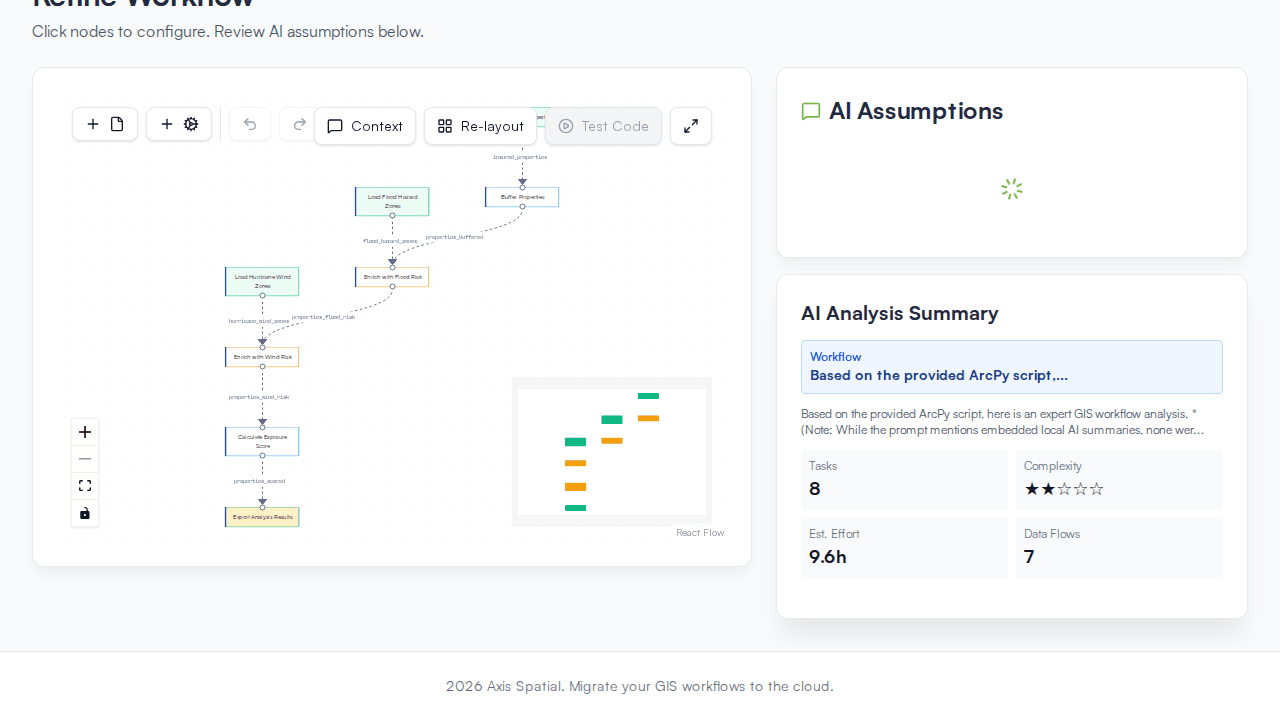
Present the inferred dependency graph and ask targeted questions about platform, data quality, business rules, error handling, and validation expectations.
Generate a candidate, not a verdict
Planner, grounded retrieval, builder, and documentation stages produce code, configuration, orchestration, tests, runbooks, and migration notes for the chosen target.
Review, revise, and reject when necessary
Deterministic checks, a pre-deployment gate, independent audit, targeted revision, and reconciliation keep unresolved runtime or equivalence problems visible.
04 · Human control
A person corrects inferred assumptions before generation. Deterministic checks and a pre-deployment gate then determine whether a candidate may proceed.
Independent review, bounded revision, and final reconciliation keep unresolved runtime and equivalence errors visible instead of turning generated volume into a success claim.
05 · Outcome
The strongest retained run scanned 14 linked assets around a representative legacy exposure-distribution workflow and generated a 21-artifact AWS candidate bundle.
Two reviewer passes still rejected the final verification stage after finding invalid EMR Serverless semantics, broken S3 checkpoint logic, missing configuration requirements, and testing gaps.
That is the commercially useful proof: the agent made a complex modernization proposal inspectable and exposed unsafe output before anyone could call it deployable.
06 · Proof
Evidence, not adjectives
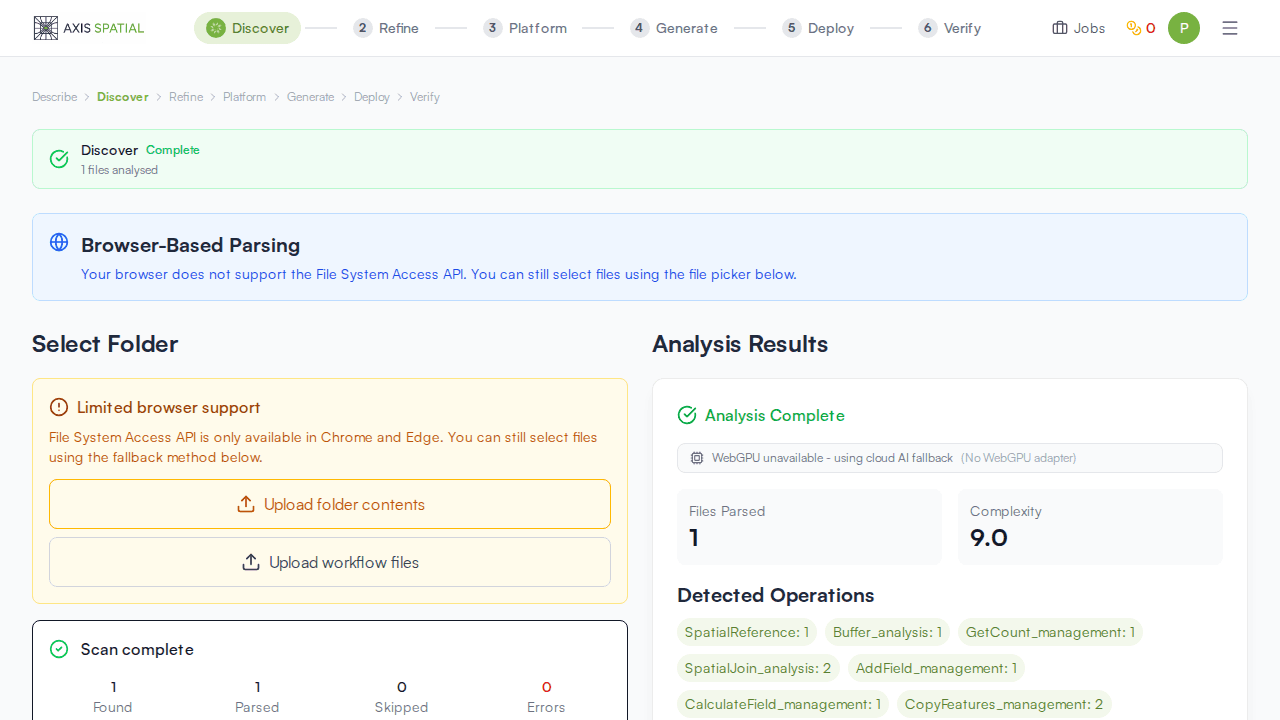
Source discovery evidence
The retained run records the linked asset inventory, detected operations, dependency context, and analysis output used by the agent.
Candidate bundle
Generated artifacts include processing steps, configuration, orchestration, tests, runbook, architecture, data dictionary, and migration notes.
Failed verification preserved
The final evidence reports review errors rather than converting a substantial generated bundle into an unsupported success claim.
Similar problem?
Start with one evidence-backed workflow.
Bring one painful process, representative inputs, and the output that matters. We will scope the smallest paid slice that can prove the path.