Operational agent workflow
Client deployment · Manager approval · Demo and workflow evidence
Turning WhatsApp messages into governed business actions
An operations system for interior-design teams where workers can report attendance, request materials, raise issues, and send progress photos in natural language while the platform structures, routes, and records the work.
- deployment
- Client
- approval authority
- Manager
- evidence
- Workflow
01 · Problem
Site operations often arrive as calls, photos, voice notes, and short messages. Attendance, material requests, safety issues, leave, and progress updates then have to be copied into separate systems by office staff.
A useful agent had to meet workers in WhatsApp, understand mixed English and transliterated Malayalam, convert the message into a typed operational record, and preserve the firm's approval rules.
02 · Axis Agents’ role
Axis Agents designed and built the end-to-end workflow across the three role-based portals, Fastify API, PostgreSQL and Redis state, WhatsApp integration, AI message pipeline, photo handling, notifications, and approval chains.
The model acts as an interpreter and router inside a business system: deterministic records and workflow rules remain the operating truth.
03 · Agentic system
What was built
Classify the request
The message pipeline distinguishes attendance, material requests, issue reports, leave, work updates, photos, questions, and unknown input.
Extract typed entities
Item names, quantities, dates, locations, and severity are extracted from natural language, including relative dates and mixed-language phrasing.
Route into the operating system
The agent creates supported attendance, issue, photo, schedule, task, or request records and routes wired actions into configured approval or escalation workflows.
Clarify or confirm
High-confidence work receives a confirmation in the worker's language. Low-confidence input asks for clarification instead of guessing, while approvals remain with managers.
04 · Human control
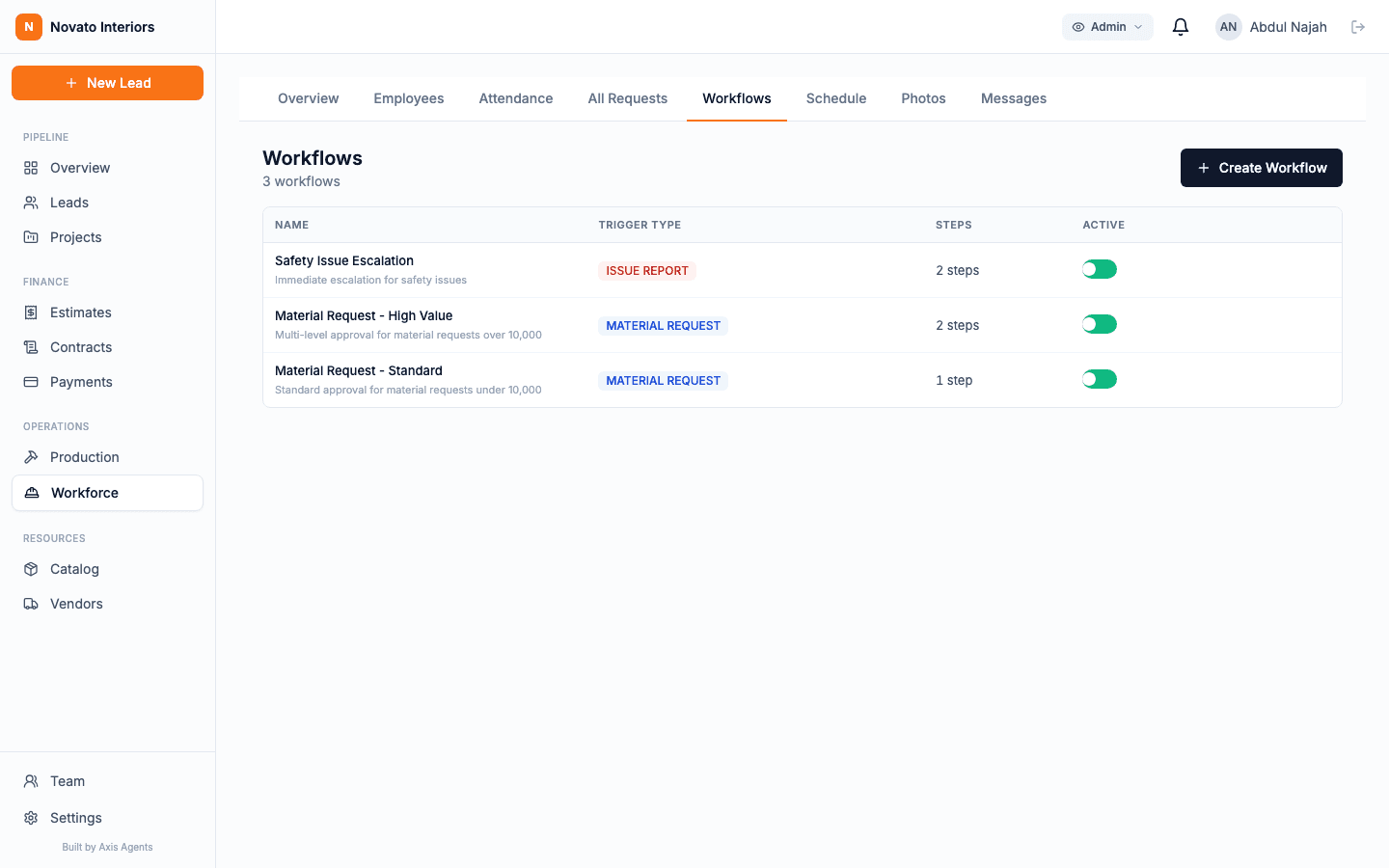
Workflow definitions, approval steps, escalation paths, and active state exist outside the model prompt. Managers and supervisors retain authority over approvals and consequential actions.
Low-confidence input asks for clarification rather than guessing, and the public surface uses representative demo data rather than private operational records.
05 · Outcome
A deployed operational system connecting admin, client, and employee portals with a WhatsApp-based workforce channel.
The build proves a practical message-to-action pattern: natural language becomes structured state, workflow rules decide the route, and people keep authority over approvals and escalations.
The pattern transfers to field service, construction, facilities, logistics, and other teams whose real workflow happens in messages rather than forms.
06 · Proof
Evidence, not adjectives
Live demonstrator
The public product exposes role-based operational portals and demo access.
Message-to-action implementation
The repository contains the WhatsApp handlers, intent classification, entity extraction, photo analysis, database actions, and response routing.
Visible control layer
Configurable workflows show the trigger type, approval steps, escalation path, and active state outside the model prompt.
Similar problem?
Start with one evidence-backed workflow.
Bring one painful process, representative inputs, and the output that matters. We will scope the smallest paid slice that can prove the path.